
Assessment (Mobile Technology & Programming)
Assessments
Lab Assignment : 30%
Group Project : 30%
Final test : 40%
Total: 100%
Passing grade : C ( 50 % )
Final Test : 40% (05/1/2027)
Date: 05/1/2027 (Wednesday)
Time: 10.15 – 11.15 am
Duration: 2 Hours (excluding submission time 10 minutes)
Chapter 1-7
Type:
Part A – Objective- (20 questions) – 20 marks (Close book)
Part B – Subjectives (2 short questions) – 30 marks (Open book for Part B (Question 2 only)
Just type your answer in the paper and attach it as .pdf file in UFuture.
Hint: Code the xml and java file.
GOOD LUCK 🙂
Lab assignment: 30% (5/12/2026)
This lab assignment is an individual assignment. Students can discuss and refer to any related resources as long as they manage to design and develop the mobile app by themselves. In this lab assignment, students are required to use Android Studio IDE.
This lab assignment is about personal app. It is meant that students can share information about themselves such as:
- About me (One page only)
- Skills (One page only)
- Hobbies (One page only)
Note: Please use your own creativity to develop the above pages.
It also has quick links to UiTM Website and iStudent Portal.
App icon and splash screen should be included.
There are several elements to take into the consideration in developing the mobile app.
- Navigate Drawer
- TextView
- Button/ImageButton
- ListView
- WebView
- Imageview
Students have two weeks to finish this lab assignment. For the time being, I will evaluate it using your mobile phones. In case if you don’t have any android device, I will evaluate it through the emulator.
Please see the appendix for the example of the mobile app pages.
Appendix: The example of the mobile application pages are shown as below:
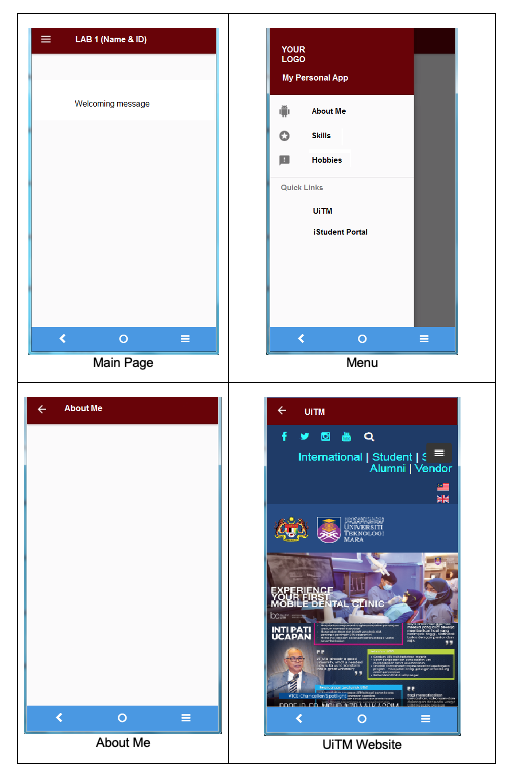
What to submit:
- Project files
- Video of the app
Put both of the files in the google drive and share the link in the UFuture (I will create the assignment in UFuture later).
The evaluation rubric
| Criteria | CONTENTS (3 PAGES) (1-5) | ELEMENTS (5 FEATURES) (1-5) | CORRECTNESS (1-5) | INTERFACE (1-5) | COMPLETION (1-5) |
| Description | 3 pages existed in the application | All 5 features are used in the application | The application is correctly developed without error | The view of the interface | The completion of the application |
Group project:
10%(proposal) – 17/12/2026
20%(Mobile App) – 31/1/2026
Group project requirement
This group project is especially designed as a platform for students to improve their soft skills such as logical thinking, critical thinking, problem solving, programming and esprit de corps. The ideal group size is 4 – 5 members. It is recommended that the group size is as small as possible. By doing this, perhaps each student will give full commitment to the project. This is to make sure that there is no sleeping partners in the group. A project leader is appointed and responsible to the success of the group.
The time duration of the group project is seven weeks starting from assigning the project title until the project presentation.
Each group is required to provide with the followings:
- Proposal/report document (softcopy)
- Project file mobile application (softcopy)
Report
Format:
- In Power Point
- Font type: Times New Roman / Arial
- No. of slides: 10 – 15 slides
- Cover page – course, group, project title, prepared by and prepared for
Content
- Title
- Problem statement
- Objectives – 2 to 3 objectives
- Scopes
- Members’ particular details – ID and name & Job assignment
- User interface design
- Database design – ERD
- Methods/techniques applied
Application
Please ensure that the mobile application adheres to the following conditions:
- The mobile app has login & logout functions. Only the registered users can access the mobile app based on their authorizations.
- The database is either SQLite or MySQL. For those who use MySQL database will be rewarded extra marks.
- The CRUD functions for at least one table.
- Produce a simple report from the database.
Implementation
- Students must use Android Studio IDE to develop the mobile application.
- Students may have a local host to locate the MySQL database server, in case they are using the MySQL database.
- The mobile application is run on pc/laptop and viewed by using the android emulator/android device because the lecturer need to see the source code in order to evaluate the students’ understanding on the subject matter.
The evaluation rubric
- Report
| 5 – 4 marks | 3 – 2 marks | 1 – 0 mark | |
| 1. Organization | The contents are organized and explained very well | The contents are less organized and explained | The contents are notorganized and explained at all |
| 2. Contribution | All requirements and objectives are identified, evaluated and completed | All requirements are identified and evaluated but some objectives arenot completed | Many requirements and objectives are not identified, evaluatedand/or completed |
- Mobile App
| 5 – 4 marks | 3 – 2 marks | 1 – 0 mark | |
| 1. UserInterface | Interface is neat and well organized | Interface is reasonably neat | Interface is untidy and not organized |
| 2. Run without error | Runs smoothly and without errors | Runs but with some errors | Still contain error or warning |
| 3. Correctness | Application is according to theoriginal proposal and givescorrect output | Application follows the original partially or givessome incorrect output | Application is completely incorrect |
| 4. Database | CRUD functions for at least one table without errors | CRUD functions for at least one table with some errors | No database used at all |
The full marks are 30 marks in which 10 marks for the report and 20 marks for the mobile app.
Course syllabus & Schema of work (Mobile Technology and Programming)
This course introduces students to mobile programming technologies for designing, developing, and publishing mobile applications across multiple platforms. It provides fundamental knowledge and techniques for leveraging device capabilities, adhering to current technologies and standards, implementing security measures, and working with various mobile operating system software development kits (SDKs). Emphasis is placed on building efficient, secure, and user-friendly mobile applications while fostering entrepreneurial and analytical skills. By the end of the course, students will be able to analyze mobile programming frameworks to support diverse online communities, build efficient and secure mobile applications for multiple devices, and demonstrate entrepreneurial skills in mobile application analysis. Teaching methods include lectures, laboratory sessions, and discussions, while assessments consist of tests, assignments, and group projects.
At the end of the course, students should be able to:
- Understand the concepts of mobile programming frameworks in support of a diverse online community.
- Develop a mobile application that is usable, efficient and secure on more than one device.
- Demonstrate entrepreneurial skills in the development of mobile application.
Course Syllabus
| Topic | Remarks |
|---|---|
| WEEK 1 (28/09/26-02/10/26) Chapter 1 – Introduction to Mobile Programming 1.1 Internet and networking 1.2 HTML and CSS 1.3 XML 1.4 Java 1.5 Mobile Apps architecture 1.6 Mobile Apps vs. Web Apps 1.7 Android vs. IOS | Start Entrance Survey (28 September) Lecture 1:: Ebooks Lab 1: Installation of Android studio |
| WEEK 2 (05/10/26-09/10/26) Chapter 1 – Introduction to Mobile Programming 1.1 Internet and networking 1.2 HTML and CSS 1.3 XML 1.4 Java 1.5 Mobile Apps architecture 1.6 Mobile Apps vs. Web Apps 1.7 Android vs. IOS | Lecture 2: Introduction to Mobile Programming Lab 2: Develop my first app |
| WEEK 3 (12/10/26-16/10/26) Chapter 2 – Introduction to Android Operating Systems 2.1 History 2.2 Features 2.3 Version 2.4 Android architecture | End Entrance Survey Lecture 2: Android Operating Systems Lab 3: XML and layout in Andriod |
| WEEK 4 (19/10/26-23/10/26) Chapter 2 – Introduction to Android Operating Systems 2.1 History 2.2 Features 2.3 Version 2.4 Android architecture | Start Lab assignment – 30% Lecture 3: Android studio Lab 4: UI view in Android |
| WEEK 5 (26/10/26-30/10/26) Chapter 3 – Android studio 3.1 Getting Started 3.2 First Application 3.3 Project Structure (manifests, java, res and build.gradle) 3.4 Activities, Fragment, Services, Intent and UI Widgets 3.5 Layouts 3.6 Containers 3.7 Menu | Lecture 4: Developing Application I Lab 5: Android widgets |
| WEEK 6 (02/11/26-06/11/26) Chapter 3 – Android studio 3.1 Getting Started 3.2 First Application 3.3 Project Structure (manifests, java, res and build.gradle) 3.4 Activities, Fragment, Services, Intent and UI Widgets 3.5 Layouts 3.6 Containers 3.7 Menu | Lecture 5: Developing Application II Lab 6: Andriod navigation |
| WEEK 7 (09/11/26-13/11/26) Chapter 4 – Developing Application I 4.1 Layouts (Linear Layout, Relative Layout) 4.2 UI Widgets (TextView, EditText, Button, ImageView, 4.1 4.3 RadioButton, CheckBox, Spinner, ScrollView) 4.4 Event Handling and Event Listener 4.5 Fragment and Intent 4.6 Toast (Simple Toast) 4.7 Containers (WebView) | Project briefing (Create groups) Submit lab assignment – 30% (5/12/2021) Start group project – 30% Lecture 6: Mobile Database Lab 7: Android database(SQLite) |
| WEEK 8 (16/11/26-20/11/26) Chapter 4 – Developing Application I 4.1 Layouts (Linear Layout, Relative Layout) 4.2 UI Widgets (TextView, EditText, Button, ImageView, 4.1 4.3 RadioButton, CheckBox, Spinner, ScrollView) 4.4 Event Handling and Event Listener 4.5 Fragment and Intent 4.6 Toast (Simple Toast) 4.7 Containers (WebView) Test 1 – (20%) | Lecture 7: Implementing CRUD Lab 8: SQLite CRUD |
| WEEK 9 (23/11/26-27/11/26) Chapter 5 – Developing Application II 5.1 Menu (Option Menu) 5.2 Navigation (Up Button/Back Button) 5.3 Data Storage (SharedPreference) 5.4 Date and Time (DatePicker, TimePicker) 5.5 Notification (Simple Notification) Chapter 7 – Implementing CRUD 7.1 Login and Logout and registration 7.2 Add, Retrieve, Update & Delete Operations 7.3 Reporting 7.4 Searching | Project proposal submission (17/12/2021) Lecture 8: Testing and Publishing Apps Lab 10: Testing and publishing |
| WEEK 10 (30/12/26-04/1/26) Chapter 5 – Developing Application II 5.1 Menu (Option Menu) 5.2 Navigation (Up Button/Back Button) 5.3 Data Storage (SharedPreference) 5.4 Date and Time (DatePicker, TimePicker) 5.5 Notification (Simple Notification) | Start Student Feedback Online (SuFO) Lecture 9: Revision activities Lab 10: |
| WEEK 11 (07/12/26-11/12/26) Chapter 6 – Mobile Database 6.1 Introduction to SQLite Database 6.2 Database design 6.3 Database connection 6.4 Database access using SQL Group project preparation | Lecture 11: Revision activities Lab 11: Project preparation |
| WEEK 12 (14/12/26-18/12/26) Chapter 6 – Mobile Database 6.1 Introduction to SQLite Database 6.2 Database design 6.3 Database connection 6.4 Database access using SQL Group project preparation | Lecture 12: Revision activities Lab 12: Project preparation |
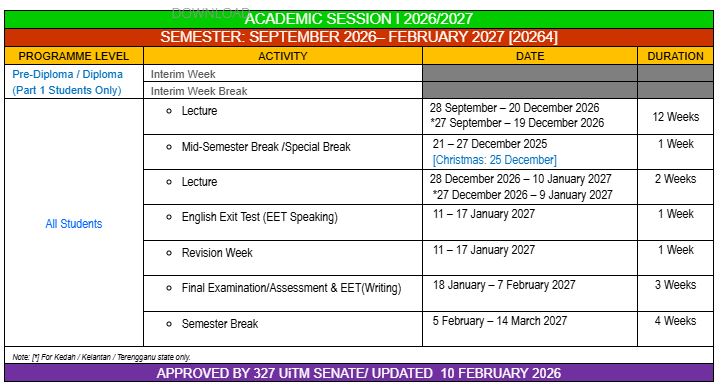
| (21/12/26 – 27/12/26) | Mid semester break |
| WEEK 13 (28/12/26-01/01/27) Chapter 7 – Implementing CRUD 8.1 Login and logout 8.2 Registration 8.3 Create, read, update, delete Group project preparation | Lecture 12: Revision activities Start Exit Survey (17-30 January 2021) Start Exit Student Feedback Online (SuFO (20/12/2021 – 6/2/2022) Lab 13: Project preparation |
| WEEK 14 (04/01/27-08/01/27) Chapter 7 – Implementing CRUD 8.1 Login and logout 8.2 Registration 8.3 Create, read, update, delete Testing and Publishing Apps – Mobile application and delivery – Testing mobile application – Application distribution Test 2 – (20%) | Lecture 14: Revision activities Test 2 – (2/1/2027) (40%) End Exit Survey End Exit Student Feedback Online (SuFO) Project preparation Lab 14: Project preparation |
| (09/01/27 – 17/1/2027) Group project presentation | Submit group project – 30% (31/1/2021) Group project presentation (3-4/2/2022) Study week |
SESI OKTOBER-MAC 2021
Flutter-Bottom menu
Layout
Change app name
How to change app name:
Android
Open AndroidManifest.xml (located at android/app/src/main)
<application
    android:label="App Name" ...> // Your app name here
iOS
Open info.plist (located at ios/Runner)
<key>CFBundleName</key>
<string>App Name</string> // Your app name here
Don’t forget to run
flutter cleanMap
You can upload and share everything relating to use map Flutter. You also can download it, if it’s useful to you.
https://blog.codemagic.io/creating-a-route-calculator-using-google-maps/
https://github.com/sbis04/flutter_maps
or
https://www.digitalocean.com/community/tutorials/flutter-geolocator-plugin
https://github.com/sbis04/flutter_maps (try this, interesting)
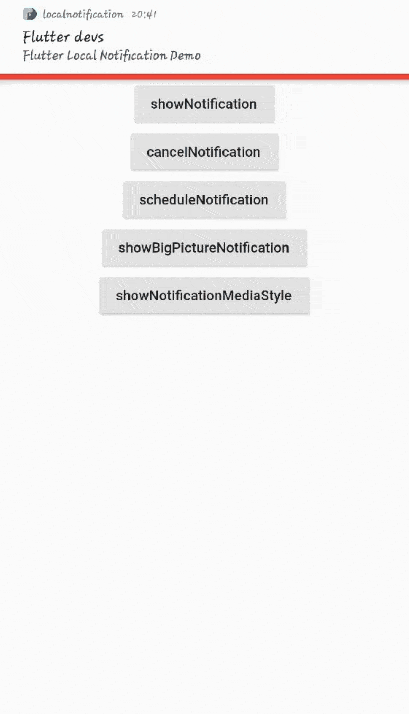
Notification
You can upload and share everything relating to the notification in Flutter. You also can download it, if it’s useful to you.
Use MySQL
You can upload and share everything relating to use MySQL for database in Flutter. You also can download it, if it’s useful to you.
CRUD MYSQL
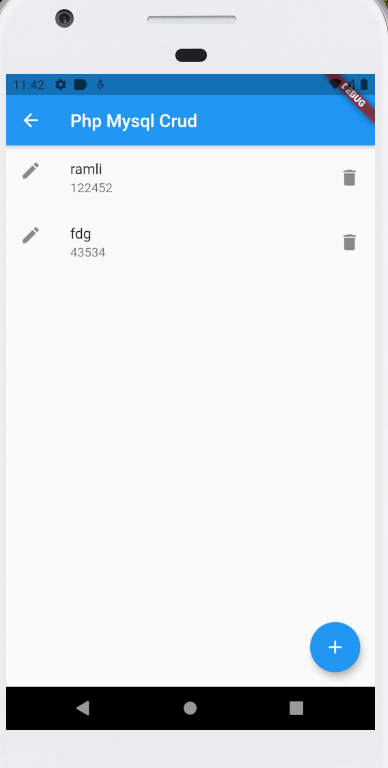
Error: Bad state: Insecure HTTP is not allowed by platform:
Just add in android/app/src/main/AndroidManifest.xml:

<uses-permission android:name="android.permission.INTERNET" /> <!-- This Line -->
<application
        android:name="io.flutter.app.FlutterApplication"
        android:label="receipt"
        android:usesCleartextTraffic="true" <!-- This Line -->
android:icon="@mipmap/ic_launcher">Augmented reality (AR)
You can upload and share everything relating to the Augmented reality in Flutter. You also can download it, if it’s useful to you.